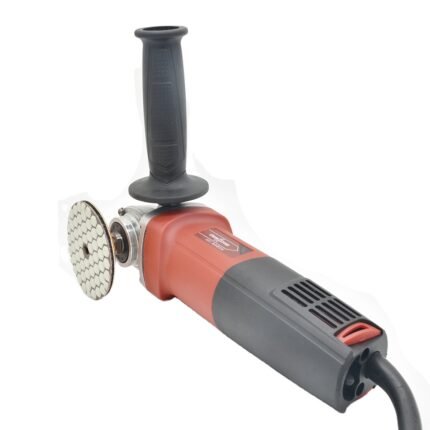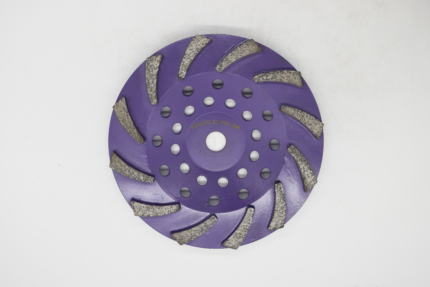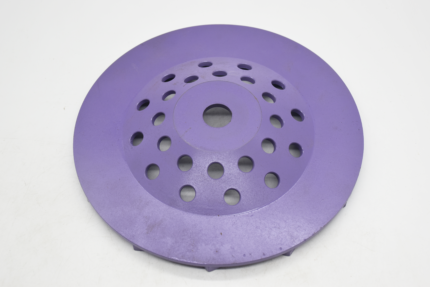
In high-volume countertop fabrication and architectural stone processing, edge profiling and edge polishing represent two of the most labor-intensive phases of production. While computer numerical control (CNC) machinery and automated bridge saws handle slab cutting with rapid cycle times, manual edge detailing and sink cutouts often create operational bottlenecks.
For decades, the industry standard has relied on a progressive 7-step abrasive sequence (#50, #100, #200, #400, #800, #1500, and #3000 grit). However, continuous advancements in diamond bond formulations have established 3 step diamond polishing pads as a viable alternative for commercial shops.
For workshop managers and procurement directors, the transition between these systems is an economic calculation rather than personal preference. This analysis examines the technical mechanics, labor economics, and surface quality metrics of both systems to determine their real-world return on investment (ROI).
Engineering Mechanics: How 3-Step Systems Function
To understand how a 3-step system operates, one must look at abrasive metallurgy. In a standard 7-step sequence, each pad features a tightly calibrated, single-sieved diamond grain size designed to gently abrade away the scratch peaks left by the previous grit.
A 3-step polishing pad cannot rely on single-size abrasive sorting. Instead, it utilizes multi-grit diamond layering embedded in a multi-phase hybrid bond matrix:
- Step 1 (Coarse/Honing): Combines aggressive cutting crystals equivalent to #50 and #100 grits with stabilizing micro-powders equivalent to #200 grit. It levels saw marks and establishes a uniform, scratch-free matte face in a single pass.
- Step 2 (Semi-Polishing): Blends the scratch-erasing properties of #400 grit with the surface-closing qualities of #800 grit, transitioning the stone directly into a satin semi-gloss.
- Step 3 (High-Gloss Finishing): Integrates #1500 micro-diamonds with dense #3000 polishing particles, closing microscopic surface pores and delivering an instant optical reflection.
By engineering the resin bond to erode at an optimized rate, the pad continuously releases fresh diamond crystals without allowing coarse grains to drag uncontrollably across the delicate finish.
Operational Efficiency and Labor ROI
The primary advantage of adopting a 3-step system is the dramatic reduction in non-cutting downtime.
1. Pad-Change Downtime Elimination
On a typical 7-step run, an operator stops the polisher, detaches the disc, washes the backer plate, aligns the new grit, and restarts the machine six times per profile. A 3-step system requires only two changeovers. Over an eight-hour shift producing 40 linear meters of countertop edges, eliminating four changeover cycles per piece saves approximately 45 to 60 minutes of pure operator time.
2. Labor Cost vs. Consumable Price
A high-grade 3-step pad carries a higher initial manufacturing cost than an entry-level 7-step disc due to its dense diamond concentration and specialized polyimide resin. However, in fabrication shops where operator labor ranges from $20 to $45 per hour, saving 40 minutes per day easily outweighs the slightly higher unit price of the consumables. The total cost-per-linear-meter decreases significantly when factoring in labor throughput.
Finish Quality: Optical Gloss Units (GU) Comparison
Can three steps deliver the same visual depth as seven? The answer depends heavily on the mineral structure of the stone:
- Engineered Quartz and Light Marble: High-purity 3-step pads perform exceptionally well. Slabs like Carrara marble, Calacatta quartz, and light granites reach 85 to 90 Gloss Units (GU) with minimal effort, providing a visual match to factory-polished faces.
- Dense Black Granites (e.g., Absolute Black, Shanxi Black): Extremely dark, fine-grained igneous stones are unforgiving. Any microscopic scratch will refract light as an unsightly grey haze. While an experienced fabricator can achieve good results with a 3-step pad on dark stone, the traditional 7-step sequence provides greater safety margin by erasing micro-hazing progressively.
Tooling Selection Matrix
To maximize workshop margins, commercial processors should assign tooling based on job specifications:
- Deploy 3-Step Polishing Pads For: High-volume commercial apartment countertops, standard residential quartz kitchen runs, jobsite installation adjustments, and high-turnover edge profiles.
- Deploy 7-Step Polishing Pads For: Premium custom monument fabrication, dark exotic natural quartzites, historic marble preservation, and deep surface restoration where maximum scratch safety is non-negotiable.
The OUDU 3-Step Advantage by Quanzhou Tianli
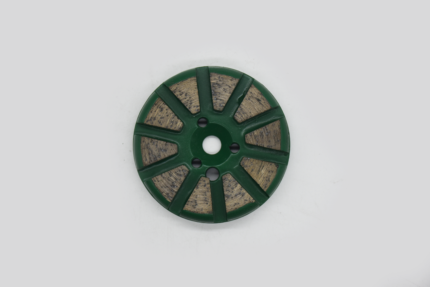
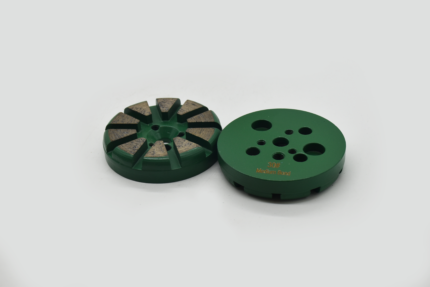
Engineered by Quanzhou Tianli Grinding Tools Co., Ltd., our OUDU brand 3-step diamond polishing pads are formulated to eliminate common failure points, such as step-skipping scratches and premature resin glazing.
Backed by more than 27 years of abrasive manufacturing since 1997, OUDU 3-step pads feature:
- High-Purity Synthetic Monocrystals: Strict diamond sorting ensures zero coarse contamination in Step 2 and Step 3 discs.
- Thermal-Resistant Hybrid Resin: Prevents polymer melting and orange-peel hazing on heat-sensitive quartz surfaces.
- Durable Waterproof Backing: Resists edge curl and delamination under continuous industrial wet-polishing conditions.
We support countertop fabricators, processing plants, and stone tool wholesalers globally with stable factory-direct supply, custom private labeling (OEM/ODM), and competitive tiered pricing.
Frequently Asked Questions (FAQ)
Can 3-step diamond polishing pads match the gloss level of a 7-step system?
Yes, on the majority of engineered quartz, light marbles, and standard granites, a premium 3-step pad will readily achieve an 85 to 90 Gloss Unit (GU) reading. However, on dense black granites, a 7-step system remains preferable for eliminating fine micro-swirls.
Are 3-step diamond polishing pads designed for wet or dry use?
Most industrial 3-step systems are engineered for wet polishing, as water helps evacuate the high volume of stone debris generated by aggressive multi-grit segments. However, specialized dry 3-step pads featuring high-temperature polyimide resins are available for jobsite installation work.
Why are individual 3-step pads more expensive than 7-step pads?
Each 3-step pad contains a significantly higher concentration of synthetic diamond micro-powders and specialized multi-phase resin bonds to perform the workload of two to three traditional grit levels. The cost savings come from reduced operator labor hours and increased daily linear meter output.
Which stones are not recommended for 3-step polishing systems?
Extremely hard, dark crystalline stones—such as Absolute Black granite or dark volcanic basalts—can sometimes reveal faint micro-hazing under harsh direct lighting when polished with 3-step pads. These specific materials benefit from the incremental safety of a 7-step progression.
Contact our technical export department today to request an OUDU 3-step evaluation sample kit or to discuss bulk wholesale pricing for your stone processing operations.