In modern stone fabrication, balancing operational speed with artisan precision is a constant management challenge. While 5-inch (125mm) discs have emerged as the industry standard for rapid straight-line edge profiling, the classic 100mm format continues to hold a dominant position on production floors.
Specifically, 4 inch diamond polishing pads remain the uncontested champions of agility, tactile control, and curved profile refinement. From internal sink cutouts to intricate architectural moldings, smaller discs provide access where larger pads simply cannot operate safely.
For commercial workshop managers and procurement heads, deploying tooling according to geometry rather than default habit is the key to minimizing scrap and optimizing throughput. This guide explores the mechanical advantages of 4-inch diamond pads and provides a framework for integrating them efficiently across your workstations.
Mastering Tight Contours: The Geometry of 100mm Pads
The physical dimension of an abrasive disc dictates how smoothly it follows irregular stone surfaces. Larger pads naturally resist bending across tight radii, whereas 4-inch pads offer decisive geometric advantages:
1. Undermount Sink Cutouts and Internal Radii
Modern kitchen and bath designs increasingly feature tight-radius undermount sink cutouts (often with interior radii of 15mm to 25mm). When a technician attempts to polish these tight internal curves using a 5-inch pad, the outer perimeter of the disc flares upward. This causes the edge of the backing plate to gouge the vertical wall or create uneven flat spots along the curve. A 4-inch pad mounted on a flexible rubber backer navigates these inside corners without binding, creating an even, uniform transition.
2. Multi-Tiered Edge Profiles (Ogee, Cove, and Bullnose)
Complex architectural details like Roman ogee, Dupont, and full bullnose edges feature concave and convex transitions. A 100mm disc conforms to these compound shapes with minimal deformation. The operator can apply localized, controlled pressure directly to the recessed curve without dragging across adjacent flat areas.
Tool Compatibility and Compressed Air Efficiency
In large stone plants utilizing central air compressors to power multiple wet polishers, the rotational resistance of the tool has a direct effect on facility overhead:
1. Lower Torque and CFM Demands
Pneumatic wet polishers have finite torque output. Spinning a heavy, wet 5-inch or 7-inch pad creates substantial fluid drag, requiring higher air volume (CFM) from the compressor to maintain target velocity. A 4-inch pad exerts significantly less rotational drag on the spindle. Technicians can achieve consistent cutting speed with lower air pressure, reducing strain on industrial compressors and extending the bearing life of pneumatic hand tools.
2. Reduced Slurry Splatter and Improved Sightlines
Centrifugal force expels coolant and abrasive slurry outward in direct proportion to pad diameter. Smaller 4-inch discs generate a much tighter, more manageable spray pattern. This keeps the working zone cleaner, allowing the fabricator to visually monitor scratch removal and gloss development without constantly stopping to wipe down the stone.
Workshop Economics: Allocating Consumables by Task
Optimizing a fabrication shop means assigning the right tool size to the right workstation to avoid consumable waste:
- Lower Unit Acquisition Cost: Due to lower raw material volume in the resin core and diamond layer, 4-inch pads carry a lower price point per unit than 5-inch counterparts. Equipping detailing benches, chip-repair stations, and tile-chamfering tables with 4-inch pads reduces overall tooling inventory costs.
- Preventing Uneven Wear: When fabricators use large 5-inch pads exclusively for edge beveling, only the outer 15mm of the pad contacts the stone, leaving the center diamonds unused. For dedicated 2cm and 3cm edge work, matching the profile to a 4-inch pad ensures the abrasive surface wears evenly from perimeter to center, maximizing diamond utilization.
- Minimizing Slab Scrapping on Custom Projects: On high-value natural marbles or brittle sintered stones, machine chatter and over-grinding can destroy an expensive slab in seconds. The gentler, more forgiving contact footprint of a 4-inch disc provides an added margin of operator control.
Operational Best Practices for 4-Inch Polishing Discs
To extract maximum lifespan and clarity from 100mm diamond pads, implement the following workshop rules:
- Maintain the Speed Window (2,500 to 4,000 RPM): Because 4-inch pads have a smaller diameter, they can be operated slightly faster than larger discs without exceeding the safe linear tip speed of the diamond bond. Keep electric or pneumatic polishers between 2,800 and 3,800 RPM during wet polishing to maintain rapid stock removal.
- Match the Backing Pad Rigidity: For straight pencil edges and arrises, pair your 4-inch pad with a semi-rigid aluminum backer to maintain absolute plane flatness. For sink cutouts and bullnoses, switch immediately to a flexible molded-rubber backing plate to allow the pad to flex smoothly across contours.
- Flush Swarf Thoroughly: Because the contact area is compact, stone debris can pack into the segment grooves more quickly if water flow is restricted. Ensure central water-feed lines are unclogged and flowing freely to flush spent slurry.
The OUDU 4-Inch Advantage by Quanzhou Tianli
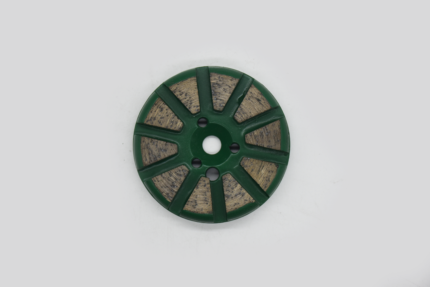
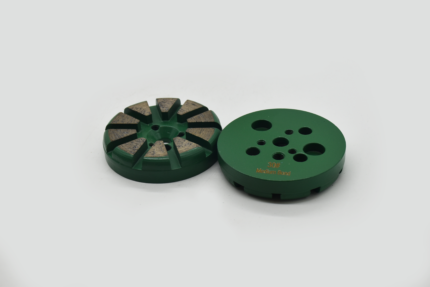
Engineered by Quanzhou Tianli Grinding Tools Co., Ltd., our OUDU brand 4-inch diamond polishing pads are designed to meet the rigorous demands of industrial detailing and custom stone fabrication.
Drawing on over 27 years of abrasive research since 1997, our 4-inch product line features:
- High-Purity Monocrystalline Diamonds: Ensuring rapid, consistent micro-shearing across granite, engineered quartz, marble, and porcelain.
- Tear-Resistant Reinforced Backing: Industrial-grade nylon hook-and-loop fabric bonded with waterproof adhesives that resist peeling during aggressive, high-speed contouring.
- Flexible Thermal-Resistant Resin: Formulated to flex over curved profiles without cracking, segment delamination, or heat-induced glazing.
We supply stone tooling wholesalers, processing plants, and equipment distributors worldwide with reliable factory-direct wholesale pricing, flexible OEM/ODM private labeling, and consistent batch quality.
Frequently Asked Questions (FAQ)
When should I choose a 4-inch pad instead of a 5-inch pad?
A 4-inch pad is the superior choice for undermount sink cutouts, tight internal corners, curved profiles (such as ogee or full bullnose), narrow tile bevels, and workstations powered by low-CFM pneumatic polishers. For long, straight linear countertop runs, a 5-inch pad offers faster square-inch coverage.
What is the recommended operational speed for 4-inch diamond pads?
For wet stone polishing on granite, quartz, and marble, run 4-inch pads between 2,800 and 3,800 RPM. Avoid running dry pads above 3,000 RPM to prevent resin overheating.
Does a 4-inch pad flex better on curves than a 5-inch pad?
Yes. The smaller radius of a 4-inch pad allows it to wrap around contours and inside curves with significantly less mechanical resistance, reducing the risk of segment cracking and tool chatter.
Can I use 4-inch pads with dry polishers?
Yes. OUDU offers specialized 4-inch dry diamond polishing pads formulated with high-temperature polyimide resins specifically engineered to withstand heat buildup without scorching stone surfaces.
Contact our technical export department today to request an evaluation sample kit of OUDU 4-inch diamond polishing pads or to discuss volume wholesale pricing for your fabrication shop.