Best Diamond Segments for Granite: How Bond, Height, and Design Affect Cut Quality and Blade Life
Introduction
Granite is one of the hardest and most abrasive natural stones used in countertops, flooring, and architectural fabrication. A diamond blade does not cut granite like a knife—it grinds through the stone with exposed diamond crystals held in a metal bond. The diamond segments are therefore the heart of any granite‑cutting diamond blade. If the bond is too hard, the diamonds dull and glaze over. If the bond is too soft, the segments wear out too quickly. The best segments for granite are not simply the most expensive one—they are the segments matched to the granite type, the saw, the cutting method, and the required finish.
1. Granite Categories
Granite varies in hardness, density, mineral composition, and abrasiveness. For blade selection, fabricators should think in practical categories rather than geological classifications.
The table below lists common granite categories and corresponding cutting requirements for diamond segments.
| Granite Category | Characteristics | Typical Cutting Demand |
| Hard, dense granite | High quartz/feldspar content, dense structure, resistant to cutting | Needs a bond that keeps diamonds exposed; avoid hard bonds that glaze |
| Abrasive granite | Minerals wear the bond quickly; cutting may be faster but blade life is shorter | Needs a medium or harder bond to resist rapid wear |
| Medium granite | Balanced hardness and abrasiveness | Medium bond and turbo rim often work well |
| Finish-sensitive granite | Visible countertop edges, tile, and architectural surfaces | Continuous rim, finer grit, wet cutting, light feed |
| Rough or non-visible cutting | Rough slab reduction, less visible work | Segmented rim for fast, aggressive cutting with good cooling |
The same granite family can vary from batch to batch. Always test on scrap or an inconspicuous edge before cutting the main slab.
2. Recommended Bond
The metal bond controls how quickly the segment wears and how efficiently new diamonds are exposed.
Use this bond selection reference table to match metal bond to different granite materials.
| Granite / Application | Recommended Bond | Reason |
| Hard, dense granite | Softer bond | Wears back to expose fresh diamonds and prevent glazing |
| Abrasive granite | Medium or harder bond | Resists rapid bond wear and extends segment life |
| General granite cutting | Medium bond | Balanced wear rate and cutting efficiency |
| Finish-sensitive visible work | Medium bond with continuous rim, fine grit | Supports smooth, chip-free cuts |
| Rough cutting | Medium or harder bond with segmented rim | Fast cutting with good cooling and debris removal |
Common Bond‑Matching Mistakes for Granite Cutting
A common mistake is using a hard bond on hard granite. The diamonds glaze over instead of cutting, and the blade begins to skid and burn. A soft bond on abrasive granite is equally problematic—it wears too fast and loses segment life.
3. Segment Height
Segment height determines how much diamond-bearing material is available for cutting. It affects blade life, cutting load, and cost per cut.
When to Replace Worn Granite Segments
Below is practical guidance for choosing proper segment height for granite cutting.
| Segment Height Consideration | Practical Guidance |
| Taller segments | More diamond layer and generally longer life; suitable for high-volume production, hard or abrasive granite, and operations with sufficient saw power and rigidity |
| Shorter segments | Lower initial cost and less load on the saw; suitable for low-volume work, lower-power saws, or applications where blade stiffness and runout control are critical |
| Worn segments | Replace when segment height reaches the manufacturer’s limit; excessively worn segments reduce clearance, cooling, and cut quality |
| Height alone is not enough | Segment height must be matched with the correct bond, diamond quality, and segment design |
A taller segment does not automatically cut faster. If the bond is wrong or the diamonds are glazed, a tall segment will still cut poorly. Segment height should be selected together with bond hardness and diamond concentration.
4. Cutting Efficiency
Cutting efficiency is not about forcing the blade through the stone. It is about maintaining a sharp, stable, and properly cooled cutting action.
Key factors include:
Correct bond exposure: The bond must wear at the right rate to expose fresh diamonds.
Quality diamonds and uniform concentration: High-grade synthetic diamonds with strong retention cut faster and last longer.
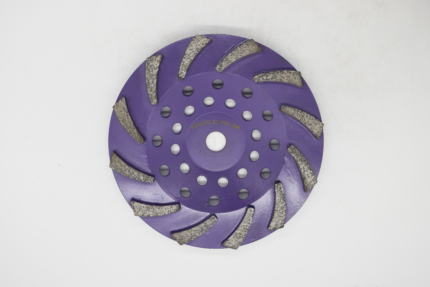
Rim and segment design: Continuous rim for smooth cuts, turbo rim for balanced speed and finish, segmented rim for fast rough cutting.
Cooling holes and slots: Help remove slurry, reduce heat, and prevent binding.
Continuous water flow: Wet cutting cools the segment, flushes abrasive slurry, and reduces dust.
Correct RPM: Never exceed the maximum RPM marked on the blade. Too high an RPM generates heat and vibration; too low can cause grabbing or stalling.
Steady, moderate feed rate: Let the blade do the work. Forcing the cut creates heat, wobble, and chipping.
Straight cutting: Do not twist the saw or apply side pressure.
Test area rule: Test the blade, RPM, water flow, and feed rate on scrap before cutting the main slab.
5. Wear Resistance
Segment wear resistance depends on the interaction of bond hardness, diamond quality, segment height, cooling, and operator technique.
Match bond to granite: Soft bond for hard, dense granite; medium or harder bond for abrasive granite.
Use quality diamonds: Cheap diamonds may fracture early, causing slow cutting and heat buildup.
Maintain water flow: Insufficient water causes overheating, slurry buildup, and accelerated bond wear.
Avoid excessive feed pressure: Forcing the blade increases heat and wear without improving efficiency.
Keep the blade running true: Check flanges, arbor, and saw alignment regularly. A loose or damaged flange causes vibration and wavy cuts.
Dress glazed segments: If the blade stops cutting or feels smooth and shiny, dress it with an abrasive stone or scrap material using light pressure and water.
Use dedicated blades: Cutting concrete, quartz, and granite with the same blade shortens life and reduces performance.
Inspect before every use: Check for cracks, missing segments, glazing, or embedded debris.
6. FAQ
Q: Can one segment type cut all types of granite?
A: Not ideally. Granite varies in hardness and abrasiveness. A soft bond works well for hard, dense granite, while a medium or harder bond may be better for abrasive granite.
Q: What bond is best for hard granite?
A: A softer bond is often preferred because it wears back to expose fresh diamonds and prevents glazing.
Q: What bond is best for abrasive granite?
A: A medium or harder bond usually lasts longer because it resists rapid bond wear.
Q: Does a taller segment always last longer?
A: Taller segments generally contain more diamond layer and can last longer, but actual life depends on bond hardness, diamond quality, water flow, RPM, and operator technique. The segment must also match the saw’s power and rigidity.
Q: Why do diamond segments glaze over?
A: Common causes include a hard bond on hard granite, excessive feed pressure, insufficient water, incorrect RPM, or a worn blade. Dress the blade or switch to a bond matched to the granite.
Q: Is wet cutting better than dry cutting for granite?
A: Yes. Wet cutting cools the blade, removes slurry, and reduces dust. Dry cutting should only be done with a dry-rated blade, at the correct RPM, with shallow passes and proper ventilation.
Q: How can I improve cutting efficiency without reducing blade life?
A: Use the correct bond and segment height for the granite, maintain continuous clean water flow, respect the maximum RPM, use a steady moderate feed rate, keep the cut straight, and test on scrap before cutting the main slab.
Conclusion
The best segments for granite are the ones matched to the stone, the saw, and the job. Choose the correct bond hardness, select an appropriate segment height, use quality diamonds, maintain proper water flow, and inspect the blade regularly. When problems appear, fix them systematically—dress the blade, adjust speed and feed, check the flange, and test again.
For fabricators looking for consistent granite cutting performance, Quanzhou Tianli Grinding Tools Co., Ltd. offers premium diamond blades and resin‑bonded diamond pads engineered for granite, with optimal bond hardness, diamond concentration, and heat resistance. Get professional technical guidance on diamond segment selection, RPM settings, and grit sequencing by contacting our team. We help stone fabricators cut and polish smarter, not harder.