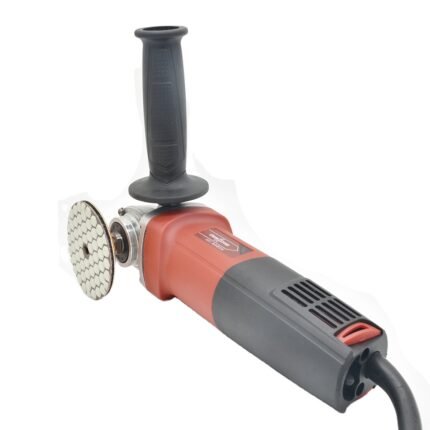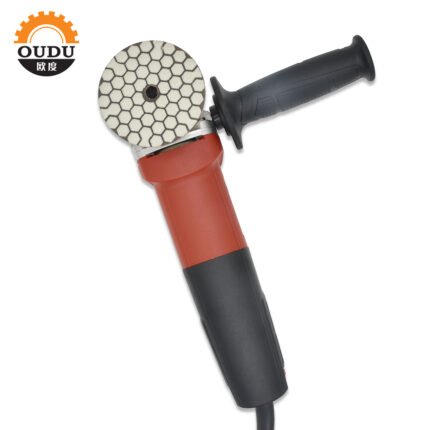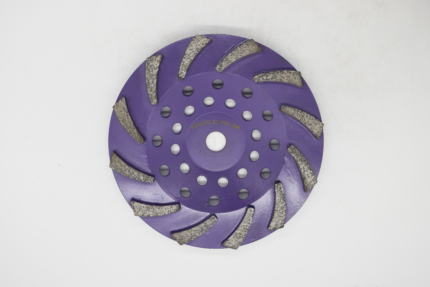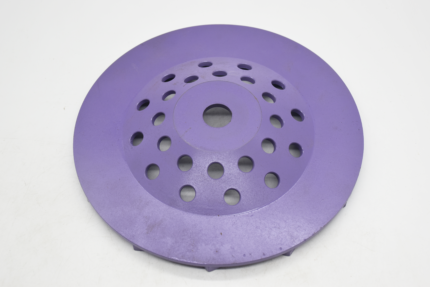
In modern stone and countertop fabrication, choosing the proper tooling size is just as important as selecting the correct diamond grit sequence. Over the past few decades, operators have used three primary disc diameters for handheld grinding and edge detailing: 4-inch (100mm), 5-inch (125mm), and 7-inch (180mm).
While 4-inch discs long served as the traditional entry-level choice and 7-inch discs dominated heavy floor work, the global stone fabrication industry has steadily converged on a single standard: 5 inch polishing pads.
From large-scale quartz countertop factories to mobile stone restoration crews, 5-inch discs have become the preferred workhorse. This technical analysis explores the geometric, ergonomic, and mechanical reasons behind why 5-inch diamond pads represent the optimum balance for handheld stone processing.
Geometric Dynamics: The 56% Surface Area Advantage
The shift from 4-inch to 5-inch pads is rooted in basic rotational geometry. The usable surface area of a circular disc increases with the square of its radius:
- A 4-inch (100mm) disc provides a working area of approximately 12.57 square inches (approx. 78.5 cm²).
- A 5-inch (125mm) disc provides a working area of approximately 19.63 square inches (approx. 122.7 cm²).
By increasing the diameter by just one inch, fabricators gain 56% more abrasive contact area per revolution.
Furthermore, at any fixed operational speed (such as 3,500 RPM), the peripheral edge of a 5-inch pad travels at a higher linear velocity than a 4-inch pad. This higher tip speed allows the diamond monocrystals to execute micro-cuts across tough quartz and feldspar minerals more frequently per second. Across a standard 30-meter kitchen countertop production run, this geometric advantage translates to a measurable 20% to 30% reduction in total edge-polishing time.
Ergonomic Balance: Protecting Motors and Operators
While a larger surface area accelerates cutting, sizing cannot be expanded indefinitely on handheld tools. This is where 7-inch pads fail in everyday edge work and where 5-inch pads achieve balance:
1. Motor Torque and Overload Prevention
Most handheld pneumatic and electric variable-speed wet polishers feature motors rated between 800W and 1,400W. A 7-inch pad creates substantial rotational drag against wet stone, forcing small motors to operate under continuous peak torque, leading to rapid thermal breakdown and armature burnout. A 5-inch pad operates comfortably within the optimal torque curve of standard polishers, maximizing tool life without bogging down the spindle.
2. Operator Wrist Fatigue on Vertical Profiles
Polishing countertop edges (typically 2cm or 3cm thick) requires operators to hold machines horizontally or cantilevered over drop aprons for hours at a time. The combined weight of a 5-inch pad and its backing plate (approx. 120–150g) keeps the center of gravity close to the machine’s drive spindle. This minimizes gyroscopic deflection, significantly reducing operator wrist strain and fatigue over an eight-hour shift.
Surface Flatness and Anti-Gouging Mechanics
Maintaining consistent flatness across straight arrises and drop edges is a hallmark of premium stone fabrication. Here, 5-inch discs offer distinct mechanical advantages over smaller 4-inch pads:
1. The “Anti-Rocker” Effect on Seams
When operators hand-polish across slab seams or areas with slight lippage using a 4-inch pad, the narrow diameter can dip into micro-depressions. This creates an unintentional rocking motion that causes unsightly “dips” and wave patterns along straight edge profiles. A 5-inch disc provides a wider bridge across high and low spots, naturally keeping the tool flat and producing true, plane surfaces.
2. Balanced Stance on 2cm and 3cm Slabs
For 2cm (3/4-inch) and 3cm (1-1/4-inch) stone slabs, a 5-inch pad offers ample surface overlap. The operator can rest half the pad stably on the top polished face while working the vertical profile or bevel, ensuring steady tracking without rolling off the edge.
Universal Machinery and Backer Plate Compatibility
The widespread adoption of 5-inch polishing pads is reinforced by tooling standardization across leading machine manufacturers:
- Spindle Thread Standardization: Major international wet polisher brands—such as Flex, Makita, Metabo, and Milwaukee—standardize their variable-speed tools around 5/8″-11 (North America) and M14 (Europe and international) threaded spindles designed primarily to support 125mm backing plates.
- Balanced Damping Backer Pads: 5-inch semi-rigid aluminum and flexible rubber backer pads absorb high-frequency rotational vibration effectively. This smooth rotation protects diamond segments from premature micro-chipping while reducing the risk of hand-arm vibration syndrome (HAVS) for technicians.
The OUDU 5-Inch Advantage by Quanzhou Tianli
To meet the demanding quality thresholds of commercial workshops, Quanzhou Tianli Grinding Tools Co., Ltd. engineers dedicated OUDU 5-inch diamond polishing pads tailored for high-output environments.
Backed by over 27 years of abrasive manufacturing since 1997, our 5-inch product line offers:
- Precision Weight-Balanced Cores: Every 5-inch pad is molded with strict mass tolerances to eliminate high-speed wobble and uneven edge wear.
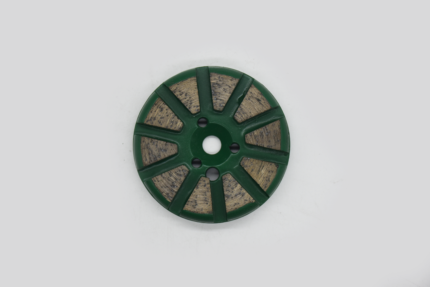
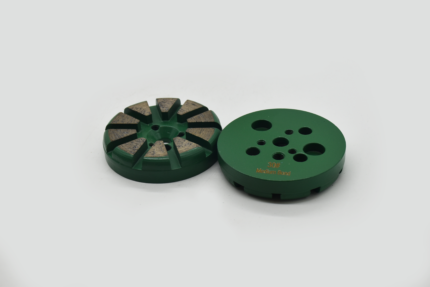
- Hydrodynamic Water Evacuation Channels: Segment designs engineered with curved drainage slots ensure continuous coolant penetration across the entire 125mm face, preventing localized dry burning.
- High-Shear Waterproof Hook-and-Loop Backing: Reinforced industrial nylon backing resists shearing forces under sustained 4,000 RPM wet runs.
We support countertop fabricators, processing plants, and stone tool wholesalers globally with factory-direct supply, OEM/ODM private labeling, and consistent batch quality.
Frequently Asked Questions (FAQ)
Can I run a 5-inch polishing pad on a tool designed for 4-inch pads?
Yes, as long as your polisher has an M14 or 5/8″-11 spindle and a motor rating of at least 800W. You will need to upgrade to a 5-inch (125mm) backing pad. Always verify that your water guard or dust shroud has enough clearance to accommodate the 125mm diameter.
Does a 5-inch pad wear out slower than a 4-inch pad?
Yes. Because a 5-inch pad has approximately 56% more surface area and contains more total diamond volume per disc, abrasive wear is distributed over a broader contact zone, typically yielding a 30% to 50% longer usable lifespan under identical working conditions.
Are 5-inch pads suitable for tight sink cutouts?
For outer perimeter countertop edges, straight bevels, and bullnoses, 5-inch pads excel. However, for tight-radius interior sink cutouts (radii under 25mm), a smaller 3-inch or 4-inch pad, or a dedicated diamond drum wheel, remains more maneuverable.
What is the recommended RPM range for 5-inch diamond polishing pads?
For wet stone polishing on granite, marble, and quartz, the optimal operational speed is between 2,500 and 3,500 RPM. For dry pads, keep speeds closer to 2,000 to 2,800 RPM to prevent heat accumulation.
Contact our technical sales department today to request an evaluation sample kit of OUDU 5-inch diamond polishing pads or to discuss wholesale distributor pricing.