Choosing the Best Cup Wheel for Concrete Grinding: A Practical Guide to Speed, Finish, and Safety
Quanzhou, China —Concrete grinding is unforgiving work. A wheel that is too aggressive for the slab can gouge a floor in seconds; one that is too conservative will glaze over, slow the job to a crawl, and leave the operator fighting the machine instead of guiding it. For contractors and fabricators,the difference between a profitable day and a costly rework often comes down to one decision: the diamond cup wheel fitted on the grinder.
A diamond cup wheel grinds concrete by exposing diamond crystals held in a metal or resin bond. As the bond wears away, fresh cutting edges are revealed. The wheel’s segment configuration, bond hardness, and grit all interact with the concrete’s compressive strength and aggregate type. No single cup wheel is “best” in isolation—the right choice depends on what the surface needs to become.
Cup Wheel Types: Matching the Segment to the Surface
Diamond cup wheels for concrete fall into several segment families, each with a distinct working character.
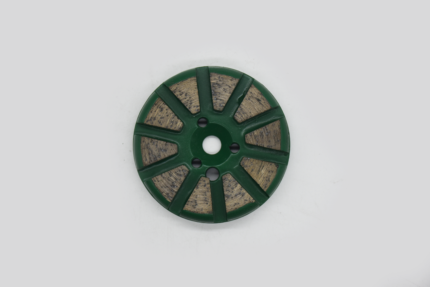
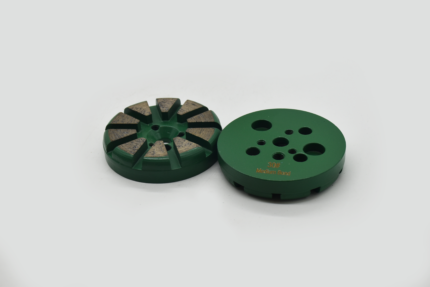
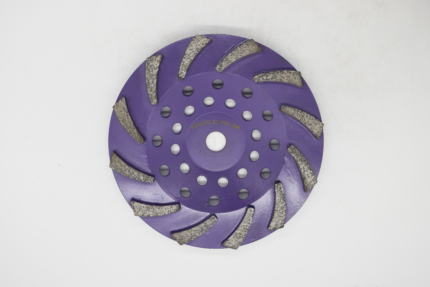
Single-row wheels carry one ring of spaced segments. With fewer contact points, the grinder’s downward pressure concentrates on a smaller area, allowing each diamond to bite deeper. This makes single-row wheels the tool of choice for aggressive stock removal, coating stripping, and knocking down high spots. The trade-off is a rougher scratch pattern and more visible swirl marks, which must be refined in later passes.
Double-row wheels place two concentric rings of segments on the face. The larger contact patch distributes pressure more evenly, reducing vibration and operator fatigue while producing a more consistent finish. Double-row wheels are the industry standard for general-purpose grinding, floor preparation before coatings, and large-area work where tool life and surface uniformity matter more than raw aggression.
Turbo cup wheels use a continuous or semi-continuous rim with cooling vents or a wave pattern. They bridge the gap between single-row speed and double-row finish, running smoother than segmented wheels while removing material faster than a standard continuous rim. Turbo wheels excel at final surface preparation, light material removal, and smoothing out grinder marks.
Arrow- or S-shaped segments angle the diamond face to create a directional cutting action. These are the most aggressive configurations, built for thick epoxy removal, heavy surface buildup, and hard, textured concrete where speed is the priority and finish is secondary.
Quanzhou Tianli Grinding Tools supplies single‑row, double‑row and turbo‑style diamond cup wheels for different concrete job requirements.
Single vs. Double Row: The Core Trade-Off
The single-vs-double decision is fundamentally a choice between bite and balance.
A single-row cup wheel is the speed demon. The concentrated pressure per segment cuts through stubborn coatings and levels uneven slabs quickly. Contractors reach for it when the goal is to move material fast and the surface will be covered by a thick overlay or coating—the rough profile it leaves can actually improve mechanical bonding.
A double-row cup wheel is the smooth operator. With twice the segments sharing the load, the wheel runs more stably, leaves fewer deep scratches, and lasts longer under continuous use. It removes material slightly slower than a single-row wheel, but it produces a more predictable surface and reduces the risk of gouging—critical when preparing a floor for thin-set, sealers, or thin-film coatings. For high-volume commercial work where consistency and tool longevity drive the budget, double-row is the default.
Bond Types: The Counterintuitive Rule That Governs Wheel Life
The most common source of premature cup wheel failure is a mismatch between bond hardness and concrete hardness. The rule is counterintuitive: hard concrete requires a soft bond, and soft concrete requires a hard bond.
On hard, dense concrete (above roughly 4,000 PSI, with quartz or granite aggregates), a hard bond holds the diamonds too tightly. The diamond faces dull instead of fracturing away, and the wheel glazes
—
it stops cutting and begins polishing the surface. A soft bond wears away faster, exposing fresh, sharp diamonds that can continue to cut the hard material.
On soft, abrasive concrete (below roughly 3,000 PSI), a soft bond wears out too quickly. The wheel sheds diamonds before they have done useful work. A hard bond resists wear and keeps the diamonds engaged longer, extending wheel life on soft slabs.
A medium bond is the practical default when slab hardness is unknown or falls in the middle range, balanced for typical residential and commercial concrete. When glazing or rapid wear appears, the first question should be whether the bond matches the concrete in front of the operator—not whether the wheel is“defective.”
We offer soft, medium and hard bond diamond cup wheels to match hard or soft concrete substrates.
Dust Control: Wet and Dry Are Both Valid—But Neither Is Optional
Concrete grinding generates respirable crystalline silica, and dust control is not a matter of preference. The two accepted pathways are wet grinding and dry grinding with engineering controls.
Wet grinding feeds water to the cutting interface, suppressing dust at the source while cooling the diamond segments and flushing abrasive slurry away. It is often the most effective method for controlling silica exposure on uneven surfaces and in areas where vacuum capture is difficult.
Dry grinding is faster and more convenient on sites without water access, but it requires a grinding shroud fitted to the grinder and connected to a HEPA-filtered vacuum. The shroud captures dust at the point of generation; the HEPA filtration prevents fine silica particles from passing back into the work environment. Dry sweeping or brushing of accumulated dust is not an acceptable substitute—wet sweeping or HEPA vacuuming is the minimum standard for cleanup.
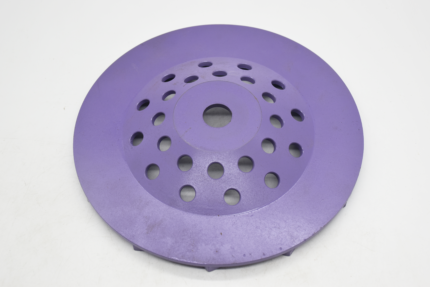
Regardless of method, the cup wheel itself must be compatible with the chosen process. Wet-rated wheels are designed for water exposure; dry-cutting wheels with cooling vents manage heat through airflow. A wheel used outside its rated application sacrifices both performance and safety.
Tianli provides both wet‑usable and dry‑type diamond cup wheels complying with standard dust‑control workflows.
Grinding Efficiency: The Variables That Actually Move the Needle
Efficiency on concrete is not simply a function of pressing harder. It is the sum of several controllable variables.
Grit sets the ceiling on removal rate and finish. Coarse grit (6–30) cuts fast and is the starting point for coating removal and aggressive leveling. Medium grit (40–80) balances removal with surface preparation. Fine grit (100–200) refines the scratch pattern for polishing or coating adhesion. Skipping grit steps does not save time; it produces a surface that later passes cannot fully correct.
Contact pressure should be controlled, not forced. On horizontal grinding, the weight of the machine is generally sufficient; leaning body weight onto the grinder loads the motor, slows rotation, and overheats the segments. If the RPM audibly drops, the pressure is too high—reduce it briefly and let the wheel recover speed.
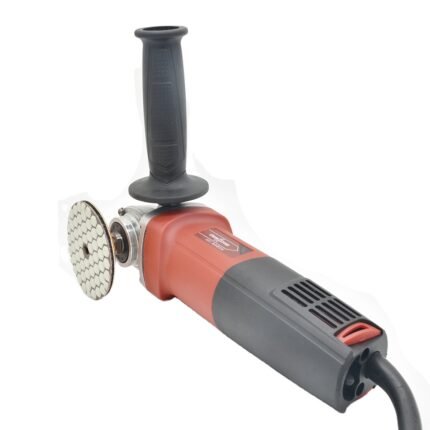
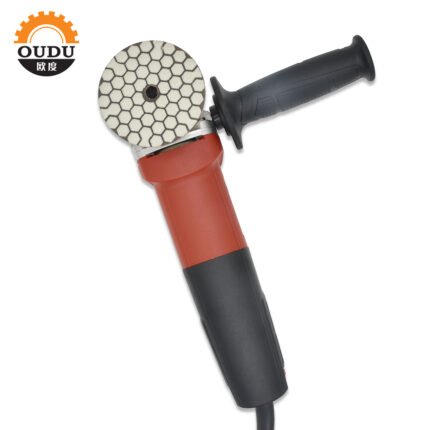
RPM and wheel diameter must stay within the tool’s rating. A cup wheel is stamped with a maximum RPM; exceeding it is a safety hazard, not an efficiency gain. Larger wheels on floor grinders cover more area per pass, but handheld angle grinders demand smaller wheels and disciplined speed control.
Segment height is an economic variable as much as a physical one. Concrete is abrasive, and the metal bond matrix wears continuously. Taller segments (10
–15 mm) cost more upfront but reduce tool changes on large projects, where downtime carries its own cost.
The most efficient grinding sequence is therefore a disciplined progression: the right bond for the slab, a coarse grit to establish the profile, intermediate grits to remove the previous scratch pattern, and a finish grit matched to the next step
—coating, overlay, or polish. Speed without control produces rework; control without speed produces overhead. The efficient job finds both.
Quick Contractor Selection Checklist
Identify concrete hardness first to pick correct bond hardness
Start with coarse grit for heavy material removal
Progress step‑by‑step through grit levels, do not skip grit sequence
Confirm RPM rating and dust‑control method before operation
Reach out to Tianli for technical support if you are unsure about wheel selection
FAQ
Can I use a single-row cup wheel for a finished floor?
A single-row wheel can remove material quickly, but its rough scratch pattern requires additional refining passes. For a floor that will be coated, sealed, or polished, a double-row or turbo wheel is the more practical starting point, followed by finer grits as needed.
My wheel stopped cutting and looks shiny. What happened?
That is glazing, and it usually signals a bond that is too hard for the concrete. The diamonds have dulled instead of fracturing away. Switch to a softer bond, or dress the wheel according to the manufacturer’s procedure, to restore cutting action.
Is dry grinding always worse than wet grinding?
No. Dry grinding with a proper shroud and HEPA vacuum is a legitimate controlled method. Wet grinding is often better at dust suppression on uneven surfaces, but dry grinding can be faster and more convenient when the dust-control setup is correct.
How do I know what grit to start with?
Start with the coarsest grit that will accomplish the removal task without unnecessarily deep scratches. For coating removal or heavy leveling, 16–30 grit is common. For surface preparation before a coating, 30–40 grit establishes the profile. For polishing or finer finishing, progress through 50, 100, and beyond in steps that fully erase the previous scratch pattern.
Can one cup wheel handle every concrete floor?
No. Concrete hardness, aggregate type, coating thickness, and finish requirements vary too widely. A wheel that performs well on a soft residential slab may glaze on a hard commercial floor. Bond hardness and segment configuration must be matched to the specific slab and job goal.
What is the most common mistake contractors make with cup wheels?
Using a bond that is too hard for the concrete, then compensating with excessive pressure. The result is glazing, overheating, and slow grinding. Matching the bond to the slab and letting the diamonds do the work is the single most reliable efficiency gain.
About Quanzhou Tianli Grinding Tools Co., Ltd.
To grind concrete cleaner, cooler, and more consistently, start with a cup wheel engineered for the slab in front of you. Quanzhou Tianli Grinding Tools Co., Ltd. offers premium diamond cup wheels for concrete surface preparation, with bond hardness, diamond concentration, and segment configurations matched to the realities of residential and commercial concrete work. Our team provides technical guidance on bond selection, grit progression, RPM settings, and dust-control compatibility.
Contact us for help specifying the right cup wheel for your next concrete grinding project.
Tel/WhatsApp:+86 139 5987 5673
Web:www.tl-fj.com
Email:tianli@tianli-china.net
WhatsApp:+86 15060870889/15880902869